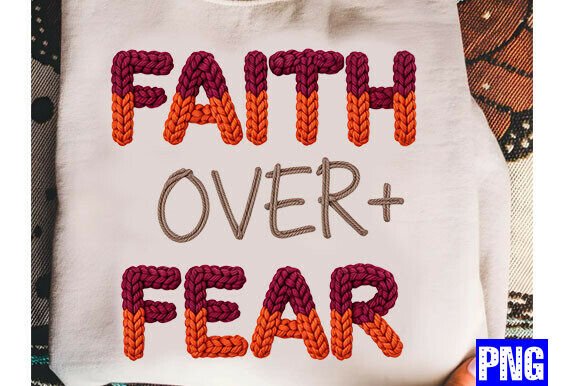
Faith over Fear PNG, Faux Embroidery Sub
First Impression: A Thoughtful, Uplifting Visual Anchor
As an embroidery designer who’s digitized thousands of logos for cafés, florists, pet brands, and handmade studios, my first impression of Faith over Fear PNG, Faux Embroidery Sub is immediate: it reads as warm, intentional, and quietly confident—not flashy, but grounded. The title alone signals emotional resonance, which is gold for small business merch. While the description confirms it’s a high-res 300 dpi PNG with transparent background (ideal for sublimation *and* embroidery prep), the “faux embroidery” cue tells me this design was crafted with stitch-friendly structure in mind—clean outlines, balanced weight, and readable letterforms even at modest sizes. It leans modern-classic: neither overly ornate nor starkly minimal. That duality makes it unusually versatile across boutique merchandise, staff uniforms, and customer-facing branded patches.
Real-World Business Use: Where This Design Earns Its Keep
Faith over Fear PNG, Faux Embroidery Sub shines where authenticity and approachability matter most. Picture it as a 2.5-inch embroidered patch on the chest of a florist’s apron—soft thread colors against linen fabric reinforce care and sincerity. Or stitched onto the front of a baker’s cap, where its clean lines hold up under daily wear and washing. For a pet wellness brand, it works beautifully on tote bags and leash tags—small enough to be subtle, strong enough to communicate values without words. As a sleeve detail on staff work shirts or a discreet label on handmade soap packaging, it adds cohesion without overwhelming. Etsy sellers report higher engagement when using designs like this as part of a consistent visual language—paired with hand-lettered tags or kraft paper labels, it elevates perceived value. And because it’s delivered as a single PNG, it integrates smoothly into digital embroidery workflows: traceable for vector conversion, scalable for printable mockups, and adaptable for both full-color sublimation and traditional thread-based applications.
Where Caution Is Key: Practical Limits for Professional Results
Even strong designs have boundaries—and knowing them prevents costly rework. With Faith over Fear PNG, Faux Embroidery Sub, avoid pushing it below 1.75 inches in finished patch size; fine interior spacing and letter separation may blur or vanish in dense stitching. Cap fronts demand extra attention: test how the curve affects legibility, especially if placing near the bill seam. On textured fabrics like heavy canvas tote bags or loop-wheel towels, consider simplifying outlines during digitizing to prevent skipped stitches or thread breaks. Dark uniforms require careful thread color contrast—run a black-and-white test first to verify silhouette integrity. Also note: while the PNG offers flexibility, it is *not* a native embroidery file. You’ll need to digitize it properly for machine embroidery design use—don’t rely on auto-trace alone. High stitch density areas (like tightly spaced letters) can cause puckering on lightweight knits unless stabilized correctly.
Brand Identity Impact: More Than Just a Logo
This isn’t just decoration—it’s a quiet trust signal. When customers see Faith over Fear PNG, Faux Embroidery Sub stitched onto a café’s reusable cup sleeve or a boutique’s gift tag, they register intentionality. That builds recognition faster than generic graphics. For small businesses building handmade product lines, it reinforces craftsmanship: the design feels considered, not templated. Consistent use across aprons, caps, and tote bags strengthens visual consistency—making your brand instantly identifiable at farmers’ markets or local events. Importantly, it avoids trend fatigue. Unlike overly stylized fonts or seasonal motifs, its balanced proportions and positive message retain relevance year after year. That longevity protects your investment in custom apparel and reduces the need for frequent redesigns.
Embroidery Designer Notes: Your Production Checklist
- Always test in black and white first—verify contrast and shape clarity before committing to thread colors.
- Check scalability: open the PNG at 1.5x, 2x, and 3x size to confirm no pixelation or soft edges compromise sharpness.
- Review spacing: ensure letter kerning remains legible when reduced for cap embroidery or small patch applications.
- Confirm hoop size compatibility: digitize with your most common hoop dimensions in mind—especially if using multi-position frames for bulk orders.
- Test on real fabric: run a sample on your target material (e.g., twill for uniforms, cotton duck for totes) with appropriate stabilizer to assess drape and stitch tension.
- Create a client-approved mockup before production—use the PNG in layered mockups showing front/back/sleeve placements.
- Compare beside existing design assets: does it harmonize with your current logo, typography, and color palette—or clash subtly?
- Verify commercial licensing: since this is sold as a digital embroidery file for cutting, confirm usage rights cover resale, branding, and promotional distribution before applying to merchandise for sale.
Final Thoughts for Small Business Owners & Decorators
Faith over Fear PNG, Faux Embroidery Sub stands out in the crowded space of T-Shirt Designs and Graphics because it bridges meaning and utility. It’s not just a phrase—it’s a brand-aligned statement that works equally well as an embroidered patch, apron embroidery, or tote bag design. For embroidery shops digitizing for local clients, it’s a reliable starting point that minimizes revision rounds. For Etsy sellers and crafters, it adds emotional depth to handmade product presentation without sacrificing professionalism. And for any small business investing in custom apparel, it delivers quiet confidence—both in the message it carries and the craftsmanship it invites. Just remember: great design is only half the equation. Pair it with smart digitizing, thoughtful thread selection, and real-fabric testing—and you’ll turn a simple PNG into a signature brand asset.