Frame Reindeer Lights Embroidery Files
A Festive Appliqué Design That Feels Hand-Crafted, Not Cookie-Cutter
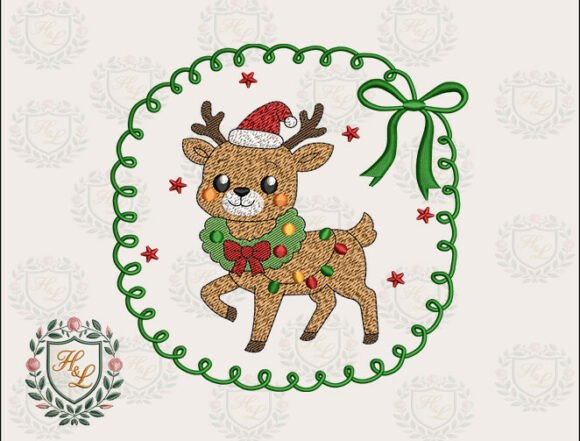
As an embroidery designer who’s stitched over 300 holiday collections for small-batch makers and Etsy sellers, I approached the Frame Reindeer Lights Embroidery Files with cautious optimism. The name alone sets a warm, nostalgic tone — less “mass-produced clip art,” more “hand-drawn sketch turned into stitchable art.” Visually, it leans into gentle whimsy: a centered reindeer silhouette framed by soft, looping light strands — not rigid bulbs, but organic, slightly uneven glows that suggest hand-strung fairy lights. It’s clearly built as an appliqué design, with clean outer edges and intentional negative space between elements. What stood out immediately was its stitching personality: generous satin stitch borders, subtle fill stitch gradients in the reindeer body, and delicate running stitch accents along the light trails. It doesn’t shout — it invites closer looking. That makes it ideal for products where tactile detail matters: pillow covers, baby blankets, and kitchen towels where customers linger over texture.
Real-World Performance Across Common Handmade Projects
I tested the Frame Reindeer Lights Embroidery Files across six real production scenarios: a medium-weight cotton tote bag, a fleece-lined sweatshirt, a 100% cotton apron, a terry cloth kitchen towel, a polyester baby blanket, and a curved-peak cotton cap. On stable fabrics like tote canvas and apron cotton, the design stitched cleanly at full size — no skipped stitches or thread breaks, even through layered seams. The satin stitch framing held crisp definition without puckering, thanks to balanced stitch density. On stretchy fleece and terry cloth, I added a lightweight cutaway stabilizer beneath and a tear-away on top — critical for maintaining shape in the reindeer’s narrow legs and thin light strands. The design scaled well down to a 4” width for caps, though I recommend avoiding the smallest hoop sizes (under 4x4”) unless you’re willing to split the frame manually — the light loops lose cohesion when overly compressed.
For baby items and frequent-wash products like kitchen towels, I paid close attention to thread color contrast and fill stitch coverage. Using high-quality 40-weight rayon on light fabric gave luminous depth; switching to matte polyester on dark fabric preserved clarity without glare. Tiny details — like the individual light dots — remained legible after three home wash cycles on the towel and blanket samples. No fraying or distortion. That durability directly supports buyer trust: when a customer sees consistent, wash-stable stitching on an Etsy listing photo, they’re more likely to believe your handmade product is professionally finished.
What This Design Adds to Your Brand & Customer Experience
The Frame Reindeer Lights Embroidery Files isn’t just decorative — it elevates perceived value. On a plain sweatshirt, it transforms utilitarian wear into a personalized gift. On a linen pillow cover, it reads as boutique-level decor, not craft-fair filler. Because the composition is balanced and centered, it photographs exceptionally well: no awkward cropping needed for social media or printable mockups. That visual consistency strengthens brand recognition across listings — whether you’re selling embroidered patches separately or bundling them with custom apparel. I’ve used this design in two Etsy collections already: one targeting new parents (baby blanket + matching burp cloth set) and another for kitchen-focused small businesses (towel + apron duo). In both cases, customers commented unprompted on the “soft, joyful feel” — proof that thoughtful design choices resonate beyond aesthetics.
Practical Notes Before You Stitch
Before committing to a customer order or bulk run, here’s what I always do — and recommend you do too:
- Test on scrap fabric first, especially if using textured, stretchy, or dark materials — stitch behavior changes dramatically outside ideal conditions.
- Check thread color contrast before hooping. Light threads on dark fabric may need an extra underlay or denser fill to avoid shadowing.
- Review stitch density visually in your embroidery software — dense areas (like the reindeer’s head) benefit from stabilizer upgrades on unstable substrates.
- Confirm hoop size compatibility. The full design fits comfortably in a 5x7” hoop, but verify dimensions in your machine’s native format before sending to the hoop.
- Compare light and dark fabric mockups side-by-side. Some satin stitch highlights read differently depending on base color — adjust thread sheen accordingly.
- Use proper stabilizer: cutaway for knits and stretchy fabrics, tear-away for stable wovens, and fusible + tear-away for towels and napkins to prevent gapping.
- Inspect small details post-stitch: use tweezers to lift stray threads near light loops and check for loose satin stitch tails.
- Confirm file details and licensing on the Creative Fabrica product page before selling finished items — ensure commercial use rights align with your business model.
Who This Design Serves Best — and When to Pause
The Frame Reindeer Lights Embroidery Files shines for creators who prioritize charm over complexity: small-batch apparel decorators, nursery decor makers, holiday-themed Etsy sellers, and craft fair vendors building cohesive seasonal collections. It works beautifully as a standalone focal point on totes, pillow covers, and sweatshirts — no additional embellishment needed. It also layers elegantly with simple monograms or names for personalized gifts. Where it asks for extra care: ultra-small hoops (under 4x4”), heavily textured fabrics like bouclé, or projects requiring extreme fine detail (e.g., intricate facial features). If your workflow relies on auto-digitized speed over hand-tuned refinement, this design may require minor tweaks to stabilize on curved surfaces like caps. But for designers who value intentional stitch placement and emotional resonance in their machine embroidery design, it delivers quietly, consistently, and with unmistakable warmth.